Teaching the Short Vowel sounds

It actually helps me to teach them the alphabet song, making them sing it more and more slowly as we go along so they enunciate the letters. Then we will proceed to teach them the sounds in the “good guy, tough guy” manner of Mary Pecci.

Here’s a hint for vowels. I had taught them the “old McDonalds” tune of AEIOU for long vowels and the alphabet song for a-z letters. I taught the children a short vowel song at the same time as the alphabet song- with hand signs, which they loved. We would go aaaapple and hold our hand out like we were fixing to bite an apple. eeeegg and hold your hands out like you are showing them an Easter egg. iiiitchy and act like you are scratching. ooooctupus and hold out both hands with thumbs turned under, wiggling the eight fingers to represent the octopus legs, and pointing with my index finger, I say uuuup. Later I start doing this with only the short sounds and not the helper words. The hand motions help them remember the sounds. Then when we are sounding something out, if they forget or I want to help them remember I can make the motion and they will remember the short vowel sound!

Sincerely, julieA

rescued by Christ, lifted by Grace

Frequently Asked Questions

Frequently Asked Questions

  1. Why do you
    homeschool?

    We started homeschooling our children because my husband
    worked a swing shift. This means he would swing from
    7-3pm, 3pm-11, and 11pm-7am. This meant that he would not
    see the children very much since they had to be in bed
    and go to school. If they stayed up late to see Daddy,
    they were cranky and sleepy. We now adjust our schedules
    to spend as much time as possible together.

    Also, we felt the children were showing signs of peer
    dependency. In other words, what the other children did
    and thought was becoming more important than parental
    expectations. We believe peer dependency is what leads to
    trouble in a lot of families. We felt pressure ourselves
    to allow the children to participate in activities we
    objected to (for a variety of different reasons) so they
    wouldn’t feel “left out” or penalized by being
    sent to “study hall” for the time period.

  2. Are you qualified
    to homeschool?

    Yes. Although I did not attend college to be an educator,
    I feel that I can teach my children as well as a
    professional educator. Better actually, because I have a
    deeply personal relationship and interest in each
    student. It is not my contention that all parents are
    able immediately to homeschool but I think they all have
    that right. My advantage is that my grandmother was a
    teacher and I loved school myself. I graduated #10 in my
    class of over 400 and had several scholarships. Later I did go back to college and graduate with Bachelor’s in Computer Information Systems as an honor student but that’s another story.

  3. What curriculum do you use?

    We use a modified Robinson Self-Teaching Curriculum program.
    Although we do not follow the RC curriculum guidelines exactly as set forth, purchasing the cds
    was the best thing I’ve ever done. It helped me to design a program that works great for us.

Teach Letter Recognition Self-teaching Program

We have been using Card Stacking to teach letter recognition. This method teaches independent study and will eventually free you to teach other children while the child learns the letters on his own. You will be surprised by how fast he learns to do this alone and enjoys working without you all day. He will not only teach himself the alphabet, upper and lower case but alphabetical order comes quickly, too.

You will need:

  • 26 4×6 or 5×7 inch letter cards with upper case letters on one side and lower case on the reverse. With all upper case facing upward, I cut off the bottom right corner if this is not already done so the child can learn to sort them easily.
  • A light colored binder with the alphabet written twice on the inside cover, once in upper case and once in lower case. It is best to copy from the cards you intend to use since the written forms should match.
  • A ziploc bag to store the cards. Clip the bottom corners to keep it from holding air when closed. I also add reinforced holes to clip the bag inside the binder.
  • To achieve greater independence, you may also wish to have a “my first” cassette player with a recording of the alphabet song and another of the alphabet spoken slowly several times.
  1. Sitting on the floor or at a table with plenty of room, begin by teaching the child to “stack” the cards by putting the corner that’s missing together on all the cards. [To the right, for upper case or left for lower case.] Do only upper or lower case each day.
  2. With the binder open, show the child how to put his finger under A or a. Say “put your finger under “a” and say ‘I’m going to find a.'” You are telling the child to say this to reinforce the letter name.
  3. Show the child how to stack the cards one at a time beside the beginning stack as he looks for the card that matches. Remind him to look if he passes the card but let him start over and find it by himself if he doesn’t notice that he missed it as he stacks the cards.
  4. When he finds it clap and say “hooray” as you show him how to make a new stack above the binder for the found letters.
  5. Say, “Good, now straighten your stack” and the first few times, help the child put the leftover cards back into a neat stack. This will make it easier to “go again” each time.
  6. Say, “Put your finger under that a/A on your binder. Now move it over (I say this as I move the finger myself the first few times) to b/B. Say ‘I’m going to find b.'”
  7. When the child says this, tell him to find it now. If he needs help, show him again how to stack the cards one at a time beside the beginning stack as he looks for the card that matches. Remind him to look if he passes the card but let him start over and find it by himself if he doesn’t notice it as he stacks the cards.
  8. When he finds it clap and say “hooray” as you show him how to place it in the found stack above the binder.
  9. Repeat throughout the alphabet, making sure the child places the found card on the found stack above the binder correctly.
  10. When he is finished, I show him how to play the “Slow ABC tape” and he reviews the alphabet as he hears it and goes through the cards with me. If you don’t have a tape, go through the stack saying the letters and showing him one at a time to reinforce.
  11. Do only upper or lower case each day. I only repeat the lesson if I am asked to do so (and I usually am asked) Please stop and do it if the child asks at any time of day during the first week.

    By the second week, they are usually doing upper or lower case upon my request and by themselves. I usually have them close to me the second week so I can observe and I like to have them bring the found stack to me when the stacking is finished so I can check that they are really in order.

You will simply be amazed at how quickly children learn to do this on their own if you enthusiastically insist that they can. If you act unsure or “help” constantly, you will not achieve independence very quickly.

My older children were taught to read by age four but since our family has grown larger and I have read more about “waiting” for formal education and learned more patience, I have allowed my children to wait until age five to even begin learning their alphabet. It evens out in the end result and if, like me, you have given up formal testing, too, you will not be worried.

I taught myself everything I really wanted to know and have confidence that if I teach them the basics, they will achieve whatever they wish to achieve. In fact, they always do better than I expected if I refrain from “instructing” them as to “how” something should be done.

Praise God.

10 Things I learned by Colette Longo

used with permission of Colette Longo [from the RC Forum].

Date: July 17, 2001 02:09 AM
Author: Colette
Subject: Things I have learned

Hi, I wrote this for another purpose, but thought I’d share it here too.

10 things I’ve learned about homeschooling:

1) Keep every thing as simple as you can. Jesus wrote with a stick in the dirt, and He was the greatest teacher that ever lived. He used no curriculum or flannel graphs or lesson plans. Homeschooling can be made far more complicated than it should be. A simpler approach is much more effective.

2) Stick to the 3 R’s. They form the foundation of life-long learning in every field because they are the tools of study. There will be no need to formalize any other subject if the children are doing their best in these 3, because people who are well grounded in reading, writing and math will approach other subjects boldly, independently and confidently.

3) Let the children teach themselves as much as they are able to. This teaches them responsibility, intellectual independence, and builds confidence. It’s also better for the parent/child relationship because you can focus on parenting instead of playing schoolteacher.

4) Use the most direct method available. For reading, read. For writing, write, for math, calculate and for Bible, read it. Don’t fall for catchy curriculums or methods that are really just something else for you and your child to learn.

5) Don’t worry about your child’s age or grade. Just let him do the best he can each day. Children grow intellectually like they do physically: in spurts. Although we may have an audience of skeptical relatives, homeschooling is not a circus, and we refuse to train our children to do tricks for people.

6) Minimize distractions in the home. Watch for excessiveness in entertainments, snacking, outings, phone conversations and the like. These things, although positive, can compete with the effectiveness of a homeschool.

7) Seek quality over quantity. A few tapes of great music, a small case of carefully chosen books, a few special play mates, and an occasional outing is better than a large, but poor quality collection.

8) If you must document your school activities, do it after the fact. This way you will not make promises you cannot keep. If you are required to make lesson plans, be as vague as permissible. Don’t give too much time and energy to transcripts, diplomas, records and the like. Keep the academic focus on learning and the rest will follow.

9) Put the needs of your youngest, most vulnerable children first. If an older child gets a little behind in school, I’m sure you can forgive yourself. But if something happened to the toddler while you were busy homeschooling, I don’t think you would be able to say the same.

10) Love the Lord your God with all your heart, mind and soul and don’t neglect to seek him early…giving him the first fruits of your day and teaching your children to do the same. I know that you are tired and that there aren’t enough hours in your day already, but we serve a God who can make the sun stand still.

I hope this helps relieve some of you homeschoolers of the burdens that we often take upon ourselves or allow others to put upon us. These are the ideas that have helped me the most.

Colette

This is borrowed from the Robinson Self-Teaching Curriculum forum with the permission of the author. This is EXACTLY how I feel, too. Thanks, Colette, I couldn’t have said it better. That’s why I’m quoting you here.sincerely, julieA
mother of ten, wife of one
God BLESS!  

Raising Auto-Didactics

At last a Reading Method for every child by Mary Pecci.

I just had to write about this. It constantly amazes me how effective this method of teaching reading has been for us. I found this book in the library after reading a review in Mary Pride’s book when I was teaching my oldest daughter to read. That was 1986 and I have used it with all the children.

This morning I was working with Sandy and am just amazed [again] at how this method turns the children into self-teachers. After she learned the abc song, she taught herself to recognize the individual letters. I showed her how to sing the song while pointing to each letter until she came to the letter she didn’t know. She loves to practice with her giant letter cards and her little pink binder. I wrote the alphabet on the binder cover, lower case on one side and upper on the other. The cards are cut on one corner so she can line them up all lower case or all upper case and practice by herself. I also made her a cassette tape of the alphabet song that she listened to over and over!

After reading the Moore’s Better Late Than Early book, I moved back the age I started teaching them reading to 6 instead of 4 and let them play more, coloring, etc. but the same method has worked with all six of our children that have started school so far despite vast differences in their personalities and learning styles. It also fosters the independence of self-teaching, encouraging them because they are able to practice even these most basic skills such as letter recognition on their own.

It’s just been so effective that I had to mention it. If RC gave me nothing else, it helped me value and teach the children to teach themselves~! I recently had a mom call me and say she wanted to homeschool her child. “I don’t want to spend much money and I don’t have time to teach her much myself.” I was taken aback and told my 17yo daughter about the call. She told me, “Well, mom, she sure called the right person. You hate to spend money and you love for us to learn things for ourselves!” This is the daughter who taught herself to sew and designs her own clothing. She also taught herself to braid her own hair in tiny little perfect rows all over her head and to cut my boys’ hair, too. RC just flows into all the aspects of our lives.

21 Day Menu: Stir Fried Cheesy Cabbage Casserole

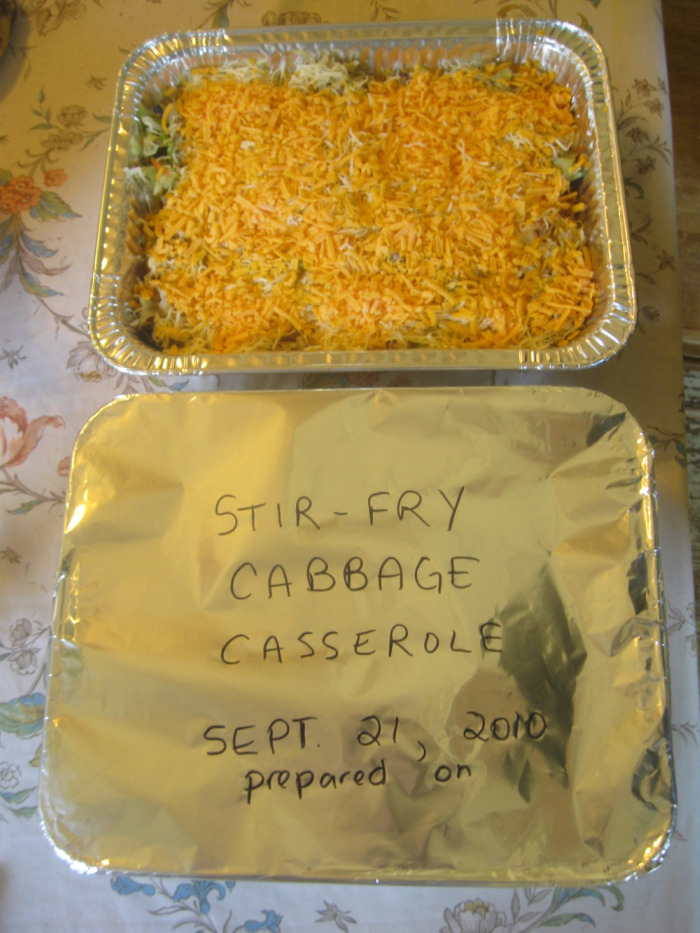
Completed Cabbage Casserole

Completed Cabbage Casserole

    Shopping List
  • coleslaw mix OR cabbage
  • ground sausage
  • shredded cheese
  • creole seasoning (to taste)
  • Cook and drain the ground sausage.

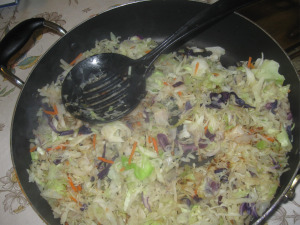
    Stir fry the coleslaw mix or shredded cabbage in a skillet on top of the stove until it is clear and browned a little bit.

    Add the ground sausage to the cabbage.

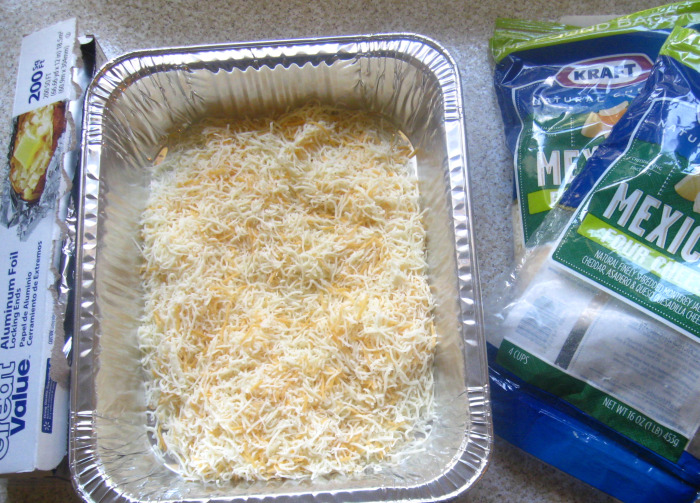
    Sprinkle part of the cheese across the bottom of a foil pan.Start Casserole

    Add the cabbage-sausage mix and sprinkle the top with the rest of the cheese. You can add the creole seasoning now or wait and let each person season their dish to their own taste.
    Cook until the cheese melts and is browned and bubbly.

    Sometimes we cook a few biscuits or garlic toast to eat with this casserole and sometimes we eat it without anything else.

    * Thanks to my good friend, Deb D’Aguiar, for this fabulous recipe. I modified it somewhat because I’m a lazy cook.

    SMART TIP: We are going to try freezing one pan of this casserole to see if it will still be good. We’ll update this later and let you know how that worked out.

    21 Day Menu: Lasagna, Garlic Toast, Green Salad

      Shopping List

    • mozzarella cheese
    • cottage cheese
    • parmesan cheese
    • spaghetti sauce
    • ground beef
    • hamburger helper lasagna mix OR egg noodles
    • green salad mix (butter and/or romaine lettuces)
    • tomatoes
    • white bread OR texas toast OR garlic bread

    Boil and drain the noodles.
    Cook and drain the ground beef. Sprinkle with the seasoning packet (if you used Hamburger Helper noodles).
    Mix the cheeses together.
    Open the spaghetti sauce.

    Layer noodles, cheese mix and beef, pouring a little spaghetti sauce over each layer. My own preference is to put a little sauce and then the beef at the bottom, then noodles, then cheese, then sauce, then repeat one more time ending with sauce at the top.

    Cook covered 30-45 minutes at 375-400, then uncover and cook another 15-30 minutes. My stove is old and doesn’t regulate itself well so time and temp varies greatly. When the lasagna is bubbly and browned on top, it is usually done and perfect.

    Let it sit for 20-30 minutes while you fix the salad and toast. Then eat and enjoy.

    Foil Pans SMART TIP: We buy foil pans from Sams Club in bulk so that we can make TWO at one time. This means we will have a day off later on!

    Love Never Fails. (a very long post studying this Word)

    Love. God is Love. Love never fails.

    We are memorizing the Bible description of love:

    Love is patient, Love is kind. It does not envy, it does not boast. It is not proud.

    That’s this week’s segment to memorize. The children repeat it after me several times, then are called upon to repeat it to me.

    The Blue Letter Bible

     http://www.blueletterbible.org/search/translationResults.cfm?Criteria=love&t=KJV

    reports that the English word “love” occurs 311 times in 281 verses in the King James Version of the Bible.
    In it first occurrance at Genesis 27:4 and its third occurance at Genesis 29:32 it is used as a verb.

    This word love is ‘ahab. Gesenius’s Lexicon, used by the Blue Letter Bible to translate the word, defines this word love:

    (1)To desire, to Breathe after anything.
    (2)To love a friend.
    (3)To delight in anything, in doing anything.

    Genesis 27:4
    And make me savoury meat, such as I <b>love</b> and bring [it] to me, that I may eat; that my soul may bless thee before I die.

    Genesis 29:32
    And Leah conceived, and bare a son, and she called his name Reuben: for she said, Surely the LORD hath looked upon my affliction; now therefore my husband will love me.

    It is here used as a verb.The outline of its Biblical usage:

    1) to love

    a) (Qal)

    1) human love for another, includes family, and sexual

    2) human appetite for objects such as food, drink, sleep, wisdom

    3) human love for or to God

    4) act of being a friend

    a) lover (participle)

    b) friend (participle)

    5) God’s love toward man

    a) to individual men

    b) to people Israel

    c) to righteousness

    b) (Niphal)

    1) lovely (participle)

    2) loveable (participle)

    c) (Piel)

    1) friends

    2) lovers (fig. of adulterers)

    2) to like
    The outline of its Biblical usage:
    1) love

    a) human love for human object

    1) of man toward man

    2) of man toward himself

    3) between man and woman

    4) sexual desire

    2) God’s love to His people

    This word love is ‘ahabah.
    The LexiConc reports that there are nineteen entries that match “love”.

    Let’s skip forward to the New Testament translations from Greek.
    There are ten reported uses:

    love, beloved
    love, charity, dear, charitably, feast of charity
    brotherly love, brotherly kindness, love of the brethren
    love as brethren
    love their husbands
    kindness, love toward man
    love of money
    love, kiss
    love to have the preeminence
    love (one’s) children.

    Since the verse I quote is 1 Corinthians 13:8, let’s look at the translation/meaning of the word in this verse.

    The King James Version of the Bible says:

    Charity never faileth…

    Charity, agape, denotes affection, good-will, love, benevolence. This is also the version of the word used in 1 John 4:8, “God is Love.”

    Vine’s expository dictionary of new testament words has this to note:

    In the two statements in 1Jo 4:8, 16, “God is love,” both are used to enjoin the exercise of “love” on the part of believers. While the former introduces a declaration of the mode in which God’s love has been manifested (1Jo 4:9, 10), the second introduces a statement of the identification of believers with God in character, and the issue at the Judgment Seat hereafter (1Jo 4:17), an identification represented ideally in the sentence “as He is, so are we in this world.”

    Never is used in the Authorized Version of the King James as never, neither at any time and nothing at any time. An adverb defined by Strong’s as denying

    absolutely and objectively- not ever.

    Fails – Vines has this note about the word translated as fails:

    Fall, Fallen, Falling, Fell:

    “to fall out of” (ek, “out,” and No. 1), “is used in the NT, literally, of flowers that wither in the course of nature, Jam 1:11; 1Pe 1:24; of a ship not under control, Act 27:17, 26, 29, 32; of shackles loosed from a prisoner’s wrist, Act 12:7; figuratively, of the Word of God (the expression of His purpose), which cannot “fall” away from the end to which it is set, Rom 9:6; of the believer who is warned lest he “fall” away from the course in which he has been confirmed by the Word of God, 2Pe 3:17.”

    * [* From Notes on Galatians, by Hogg and Vine, p. 242.] So of those who seek to be justified by law, Gal 5:4, “ye are fallen away from grace.”
    July 4, 2004 Devotion: Love, not fear, draws us to God & we CAN know His will

    It is the goodness of God that leadeth to repentance:
    Romans 2:4
    Or despisest thou the riches of his goodness and forbearance and longsuffering; not knowing that the goodness of God leadeth thee to repentance?

    Not fear of punishment, because
    1 John 4:18
    There is no fear in love, but perfect love casts out fear; for fear has torment, and he that fears has not been made perfect in love.

    and
    1 John 4:16
    And we have known and have believed the love which God has to us. God is love, and he that abides in love abides in God, and God in him.

    We can know the will of the Lord.
    Ephesians 5:9
    Wherefore be ye not unwise, but understanding what the will of the Lord is.

    Chronological Bible Study Reading Plan

    This is the Bible Reading Plan that goes with the Chronological Bible study I will be posting. The Bible Study is based on a Bible study done at Faith Bible Institute  taught by John Yates at Rowland Road Baptist Church which is based on a Bible study in the Wilmington Guide to the Bible.

    Creation Stage
    Genesis 1-11
    (Think: creation, the fall, the flood, the tower of Babel)

    Patriarchal Stage
    Genesis 12-50, Job
    (Think: forefathers or four fathers)

    Exodus Stage
    Exodus, Leviticus, Numbers, Deuteronomy
    (Think: exit us from Egypt)

    Conquest Stage
    Joshua
    (Think: conquering)

    Judges Stage
    Judges, Ruth, 1 Samuel 1-7
    (Think: cycles of sin, oppression, repentance, redemption)
    (Image: judge on a motorcycle)

    United Kingdom Stage
    1 Samuel 8-31, 2 Samuel, 1 Kings 1-11, 1 Chronicles, 2 Chronicles 1-9, Psalms, Song of Solomon, Proverbs, Ecclesiastes
    (Think: 1st king was tall; his name was Saul, David, and Solomon)
    (Image, tall king, shepherd boy king, wise rich king)

    Divided Kingdom Stage
    1 Kings 12-22, 2 Kings 1-25, 2 Chronicles 10-36, Jonah, Amos, Hosea, Joel, Obadiah, Nahum, Isaiah, Micah, Habakkuk, Zephaniah, Jeremiah, Lamentations

    Captivity Stage
    Ezekiel, Daniel

    Return Stage
    Ezra, Esther, Nehemiah, Haggai, Zechariah, Malachi

    Gospel Stage
    Matthew, Mark, Luke, John
    (Think: good news!)

    Early Church Stage
    Acts

    Epistle Stage
    Romans, 1 Corinthians, 2 Corinthians, Galatians, Ephesians, Philippians, Colossians, 1 Thessalonians, 2 Thessalonians, 1 Timothy, 2 Timothy, Titus, Philemon, Hebrews, James, 1 Peter, 2 Peter, 1 John, 2 John, 3 John, Jude, Revelation
    (Think: letters)